Kong Ming’s Eight Trigrams Maze
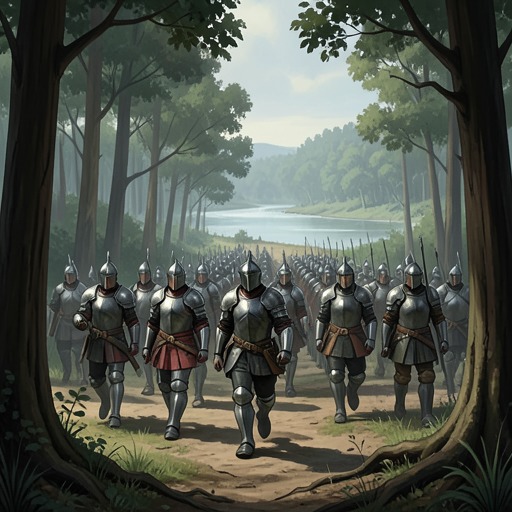
The Romance of the Three KingdomsKong Ming’s Eight Trigrams Maze is a stone formation that halts Lu Xun’s advance near Baidi after the battle with Shu. Its rocks, mist, and disorienting patterns turn a battlefield pursuit into a defensive trap; after a local guide identifies it as Kong Ming’s Eight Maze Puzzle and leads the Wu soldiers out, Lu Xun withdraws, fearing that Cao Pi may exploit the delay to attack.
Setting and Apparent Threat
As Lu Xun’s army nears Baidi, strange apparitions alarm him, and he halts the advance to investigate a suspected ambush. His men find no concealed force, only eighty or ninety piles of rocks, from which an unusual mist rises. Local people explain that Kong Ming had the piles constructed and that the mist has appeared ever since.
A wind then rises, and the soldiers are assailed by sand and rocks as the formations seem to shift in frightening patterns. The apparent danger lies not in a visible enemy but in the formation’s power to disorient and contain the pursuing force. Lu Xun recognizes that Kong Ming has deceived him, yet cannot simply retreat while trying to secure his men’s safety.
Identification and Escape
An old man appears unexpectedly and reveals that the rocks form a magical spell called the Eight Maze Puzzle. He is Kong Ming’s father-in-law, and he guides Lu Xun and his frightened soldiers out of the maze with his staff. The escape converts a bewildering landscape into a deliberate defensive device: Lu Xun’s men have entered a space whose arrangement they cannot understand, and they depend on the guide to find a way through it.
The episode’s account also associates the formation with poetic remembrance. A poem by Du Fu calls the Eight Maze Kong Ming’s signal achievement and describes the stones by the river as a tribute to the magic that stopped Wu. The poem frames the formation not merely as a trick in one encounter but as a lasting emblem of Kong Ming’s strategic reputation.
Retreat and Strategic Consequences
Although Lu Xun has won against Shu, the maze changes his immediate decision. His commanders urge him onward, but he orders the army to retreat, explaining that his concern is not the rocks themselves: he expects Cao Pi to use the opportunity to attack. Two days later, word arrives that hundreds of thousands of Wei troops have gathered at the border. Lu Xun says he anticipated this and already has plans to stop them.
The formation’s effect therefore extends beyond the soldiers it confuses. It interrupts Lu Xun’s advance at a moment when a new threat is emerging, and his retreat reflects the strategic danger of remaining committed to one front. The encounter gives Kong Ming’s arrangement a double force: it protects Shu through deception, while the possibility of Wei intervention determines what Lu Xun does after escaping.
Narrative Significance
The maze turns stones into an instrument of uncertainty. Unlike a conventional ambush, it presents no identifiable attacking force for Lu Xun to defeat; its threat comes from his inability to interpret the terrain and control the movement of his men. The old guide’s intervention supplies the knowledge that the soldiers lack, and the scene makes escape depend on understanding the formation rather than overpowering it.
Its place in the narrative also sustains Kong Ming’s reputation after his death. The stones remain by the river, while the poem and Lu Xun’s retreat preserve the encounter as evidence of his foresight. The episode links a concrete military interruption to the larger story’s enduring memory of Kong Ming as a strategist whose plans can continue to shape events after he is no longer present.